
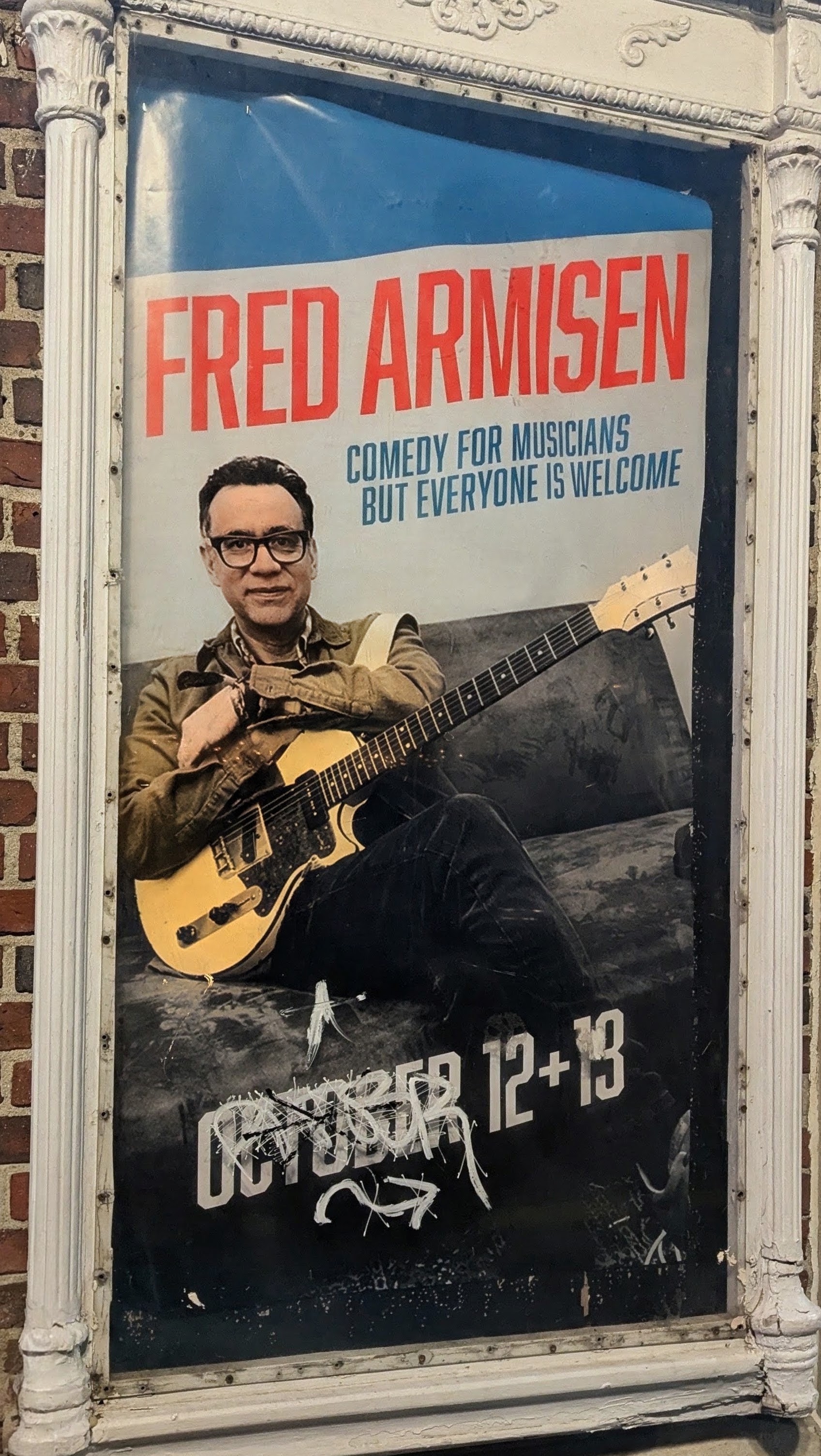
On a slightly rainy autumn evening at Boston’s historic Wilbur Theater, a crowd of roughly 900 music lovers, comedy fans, and likely a healthy contingent of Berklee College of Music students gathered for Fred Armisen’s Comedy for Musicians But Everyone is Welcome Tour. As someone who has spent a lifetime listening to, playing, and appreciating music, the promise of the title was irresistible—and Armisen delivered a night of warm, hyper-specific, and undeniably hilarious observations.
The stage setup immediately signaled that this was not a typical stand-up routine. Stage right featured a full drum kit perched on a riser alongside a rack of guitars and an electric guitar lying flat over a floor mat. Stage left held a small table with a wash basin, accompanied by an assortment of eccentric musical props—a maraca wired into an audio cable, drumsticks attached to gloves ala Edward Scissorhands, and a camera suspended over the basin. Before Armisen even set foot on stage, a montage of his legendary Saturday Night Live sketches reminded everyone of his uncanny ability to inhabit oddball characters, from “The Californians” to the reunited punk frontman playing his daughter’s wedding reception.
When Armisen casually stepped out, his opening remarks set a relaxed, conversational tone. He reminisced about his early days as a touring drummer with the punk band Trenchmouth, fondly recalling playing Cambridge’s legendary Middle East Club—first downstairs, then upstairs, which was a true rite of passage at the time. His affection for the local music scene and the venue immediately won over the Boston crowd, setting the stage for a shared, insider experience.
Equipped with an acoustic guitar and a tablet to trigger sound clips and visual aids on the overhead screen, Armisen launched into his music-focused bits. His primary target wasn’t the music industry as a whole, but the micro-behaviors of musicians themselves. He broke down the subtle anatomy of players—demonstrating the posture of “all” musicians as sloped-shouldered, skinny, and drifting across the stage rather than striding. He tackled guitar tropes with sharp precision: the pinky hammer-on on the high E string of a D chord as the ultimate hallmark of a mediocre guitarist (a guilty pleasure many of us in the audience secretly acknowledged), the E minor chord as the universal harbinger of a long, overly serious song, and the simple G chord as the dependable engine for campfire sing-alongs.
One of the night’s relatable highlights explored the social dilemma of a musician friend asking you to listen to their new recorded track. As a good friend, you listen, offer encouragement, and invest four minutes of your life. But then comes the trap: emboldened by your praise, they ask you to listen to a second track. Armisen captured that silent panic of realization with exquisite comedic timing, leaving the room erupting in knowing laughter.
“Armisen captured that silent panic of realization with exquisite comedic timing, leaving the room erupting in knowing laughter.”
Jim Dorman
The show thrived on participatory and theatrical moments. Taking a page from his classic “Garth and Kat” improvs on SNL, Armisen guided the audience through an impromptu vocal performance with the audience suggested title “Jimmy Stewart Photo Bio Pic.” He then took us on a satirical guitar strumming tour around the globe—from the heavy-handed strums of Australian rockers to the lush bossa nova of Brazil and the one-chord minimalism of Irish rock—which unintentionally spiraled into a hilarious running gag about overly dramatic Italian pop music.

Armisen’s percussion skills took center stage during a taped bit with Phil Collins’ “In the Air Tonight.” Pacing the stage during the long synth intro, he dramatically leaped onto the drum riser right before the famous fill—only to play a basic, unadorned rock beat to the crowd’s delight. Later, he got behind the kit to demonstrate the chronological evolution of punk drum beats from 1969 to 1999, showcasing genuine musicianship alongside sharp satire.
Even the oddest props served a purpose. A camera zoomed in on the wash basin as Armisen performed an overly intense hand-washing routine, poking fun at the dramatic hygiene tropes in period films like Witness. Towards the end, a mildly awkward moment occurred when an audience volunteer was brought up to read a script, but the cringe factor felt entirely consistent with Armisen’s signature brand of awkward, observational humor.
By the time the show wrapped up with a casual Q&A—where Armisen shared his reverence for George Harrison—it was clear that his performance wasn’t just a comedy show. It was a celebration of artistic quirks by someone who resides comfortably at the intersection of music and comedy. Whether you are a seasoned gigging musician or just a passionate listener, Fred Armisen’s tour is a delightful, insightful reflection on the subtle habits that make music lovers who they are.
Leave a Reply